

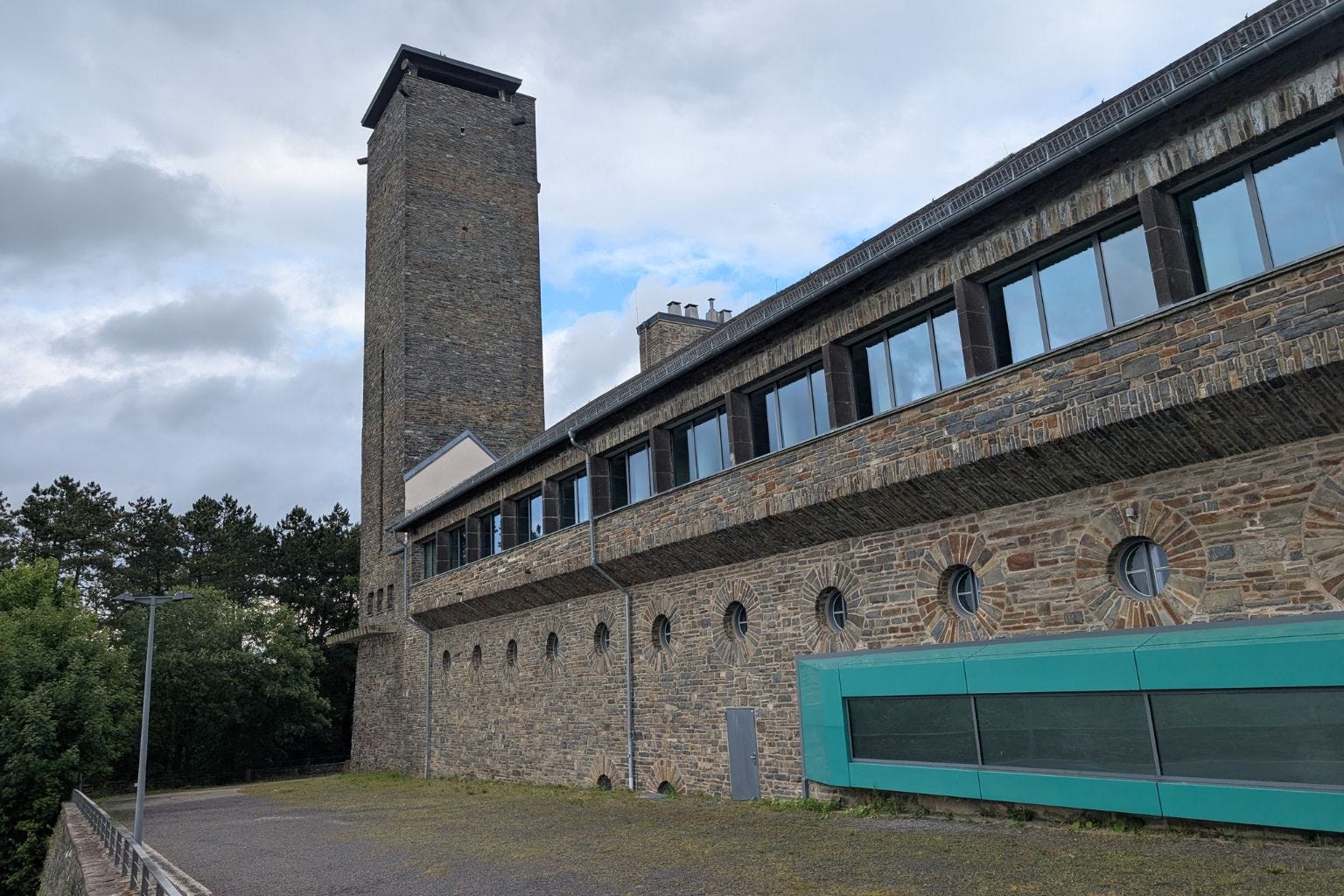
The bad and good of Nazi history and the new National Park.
Eifel National Park, established in 2004 on former military training grounds, has become a biodiverse haven for wildcats, wolves, and rare frog species, while pioneering accessible tourism for visitors of all abilities.
Nearby, the UNESCO Global Geopark Vulkaneifel sits atop geologically active land, where ancient volcanic craters, mineral springs, and human ingenuity — from medieval tunnels to global water brands like Gerolsteiner — reveal how communities have long adapted to the Earth’s power.
You can almost feel the weight of history within these thick stone walls.
The air grows heavy as you ascend the narrow, winding staircase of the Vogelsang-Turm, an observation tower with commanding views of Urftsee and Eifel National Park in western Germany.
Late in the day, with the light outside beginning to fade, . The tower is a monumental relic and a sobering reminder of a dark past.
The observation tower and the vast complex below are one of the largest architectural ensembles from the Nazi era. Like many grand designs from those times, it was never completed. Yet, even unfinished, its dominion architecture clearly projected National Socialism’s claim to power.
“This is where they educated the Nazi elite,” explains guide Stefan Schick.
In a world grappling with its own ghosts, places like Vogelsang offer an important, if painful, lesson in sustainability: the enduring necessity of confronting and preserving memory, even when it’s unpleasant. Yet this area’s own transformation is remarkable, from a Nazi castle to Allied occupation, to a new national park that focuses on its geological heritage. Together, they represent North Rhine-Westphalia’s most-visited natural attractions.
A training ground for the master race
From the top of the Vogelsang-Turm, Schick reveals the troubling story behind the tower.
Vogelsang was supposed to mold young recruits into the “ideal” human, he explained. Students here were destined to become Germany’s leaders of tomorrow. The focus was on creating Aryan men who were “faster, stronger, better,” and, as Schick added, “more deadly.”
The tower itself played a symbolic role. Schick pointed to its narrow design, meant to convey that if you climb it and you’re at the top, “you’re invincible.” It’s a psychological weapon, literally building a sense of unassailable power.
The original structure featured a 10-foot wood carving of the “ideal person” — a naked, muscular man with his right arm extended in a salute. But after the end of World War II, it was thought to be cut into pieces and used as firewood.
A permanent exhibit at Vogelsang explores the role of this facility and what it calls the “fatal attraction” of National Socialism.
It delves into daily life at Vogelsang and addresses the aftermath of World War II. In addition to the two accessible permanent exhibitions, there’s an extensive educational program in history and environmental education. The entire building complex is now used to promote peace, a sharp contrast with its original purpose.
But without this dark chapter in German history, there might not be a national park.
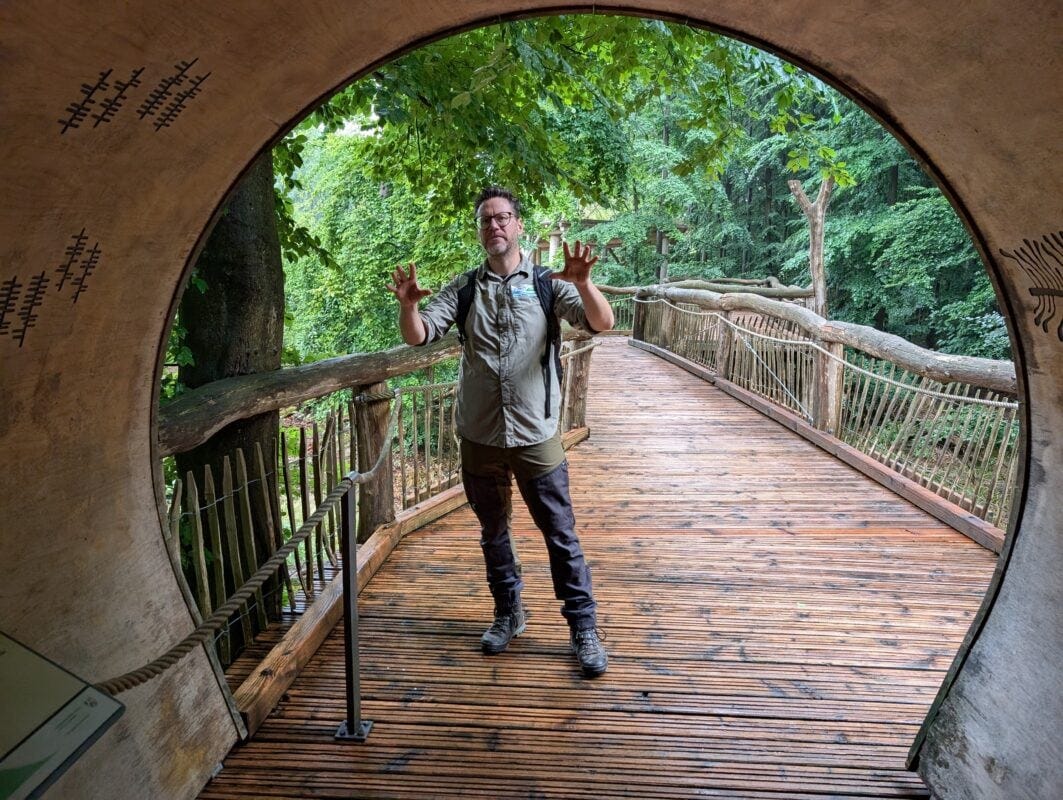
Tobias Wiesen, a representative from Eifel National Park administration, leads a tour of Der Wilde Weg (The Wild Way), an immersive path in Eifel National Park. (Photo by Aren Elliott.)
From military zones to a natural havens
Allied forces occupied the area after 1945. The Belgians, who held the area until 2006, cordoned off large swaths of land, designating it as a Militärsperrgebiet — a restricted military zone and a NATO military training area.
Eifel National Park, established in 2004, covers about 42 square miles along the Belgian border and has a well-deserved reputation as the ecological heart of the region. The park is now home to a rich variety of wildlife, including wildcats, red deer, snakes, and even wolves that have recently returned to the region after a long absence.
It’s a living sustainability case study. The transformation from military training grounds to a biodiverse national park has led to some surprising benefits. Sascha Wilden, a park ranger, says the military’s presence fostered unique habitats.
“For example, you have some very rare frog species that thrived here because the area was closed off to the public,” he says.
The park stands out for its emphasis on accessible tourism.
Tobias Wiesen, a representative from Germany’s National Park administration, says they wanted to create an inclusive environment, from tactile guidance systems and Braille signs for blind visitors to audio explanations and easy-language texts for those with mental disabilities.
“Our intention was that everybody could get the same information,” he added.
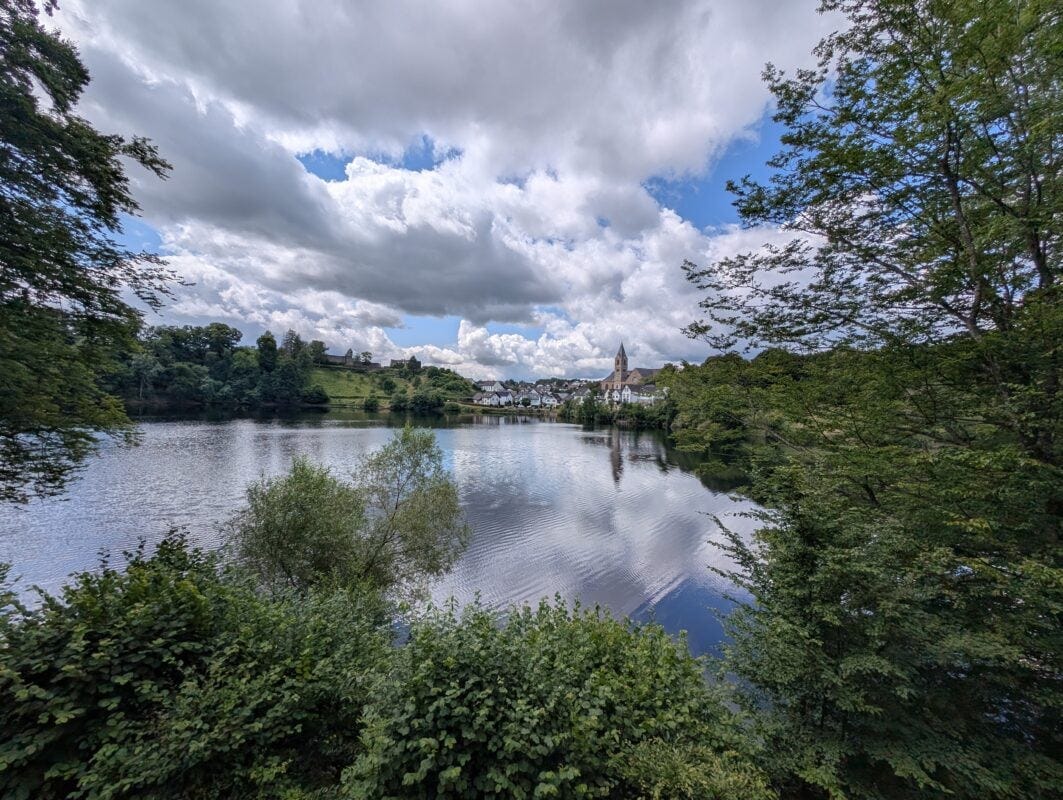
The town of Ulmen next to a volcanic lake in UNESCO Global Geopark Vulkaneifel. (Photo by Aren Elliott.)
A global geopark at Vulkaneifel
Eifel National Park is not the only place in this region that is focused on sustainable development.
Vulkaneifel, a UNESCO Global Geopark, is part of an international network of parks that focus on the region’s geological heritage. Sabine Kummer, a geologist who works in the park, says few people realize that this part of Germany is geologically active.
“We had an eruption about 10,900 years ago,” she explained. While there’s no immediate threat of a major eruption, constant monitoring tracks uplift, seismological activity, and gas emissions, confirming the presence of molten material and gases beneath the surface.
The landscape here is dotted with unique volcanic features.
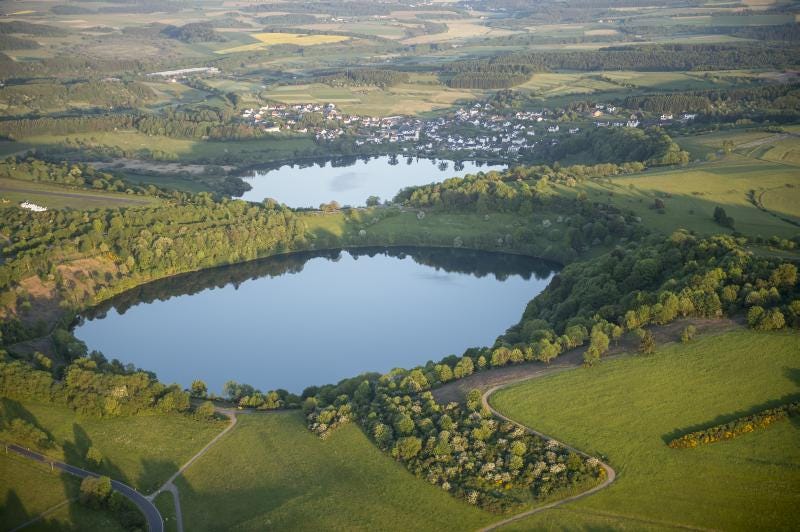
Kummer details the two types: the “scoria cones” — the classic, cone-shaped volcanoes you see in children’s books — and “maars” (volcanic craters). Maars form when rising magma interacts with groundwater, creating explosive steam eruptions that carve out deep craters. Of the 280 scoria cones and 103 maars in the region, only 12 maars are filled with water.
One of the most striking examples of this geological sustainability, and human adaptation to it, is the Ulmen Maar Tunnel, originally dug in medieval times to supply water to local mills. It’s a prime example of human ingenuity interacting with geological features. Now, it’s been transformed into an accessible public attraction, allowing visitors to walk through millennia of Earth’s history.
Perhaps the most tangible connection to the region’s active geology is its mineral water springs. These “Dreese” (local word for mineral spring) are directly linked to the deep geological processes. Carbon dioxide rises from underground, making the water naturally bubbly and rich in minerals like iron, magnesium, and calcium. This unique resource has led to a thriving mineral water industry, with companies like Gerolsteiner shipping their products worldwide.
Sustaining the past and future
Germany’s Eifel region is, in many ways, a story of sustainability in its deepest and most challenging forms. The preserved, haunting stones of Vogelsang force an unflinching confrontation with a horrific past. It’s a vital act of memory that serves as a perpetual warning.
Yet, surrounding this monument to darkness, a remarkable ecological and geological renaissance is unfolding. The former military exclusion zone, born of conflict, has blossomed into the biodiverse haven of Eifel National Park, where wildlife thrives. Nearby, the Vulkaneifel UNESCO Global Geopark reveals the earth’s enduring power, its volcanic legacy shaping not only dramatic landscapes like maars and scoria cones but also sustaining communities through mineral springs and ingenious human adaptations like the Ulmen Maar Tunnel.
Together, these sites – the preserved memory, the reclaimed wilderness, and the celebrated geology – embody a powerful truth: True sustainability demands both the courage to remember the shadows of history and the vision to nurture the living world for generations to come. The Eifel story suggests that commemorating a painful past and protecting the vibrant present are not opposing forces, but interconnected strands woven into the fabric of the future.
What do you think of this region?
Germany’s Eifel region transforms dark history and military exclusion zones into spaces of ecological renewal and geological wonder — raising questions about how we travel, remember, and connect with the past.
Should sites like Vogelsang — built to glorify dangerous ideologies — be preserved as they are, or should they be repurposed or demolished?
Have you ever visited a destination where history, nature, and geology intersected in an unexpected or powerful way?
Do you seek out “dark tourism” destinations that confront difficult history, and if so, what draws you to them

Christopher Elliott is the founder of Elliott Advocacy, and a co-founder of Travelers United, both 501(c)(3) nonprofit organizations that empower consumers to solve their problems and helps those who can’t. He’s the author of numerous books on consumer advocacy and writes weekly columns for King Features Syndicate and USA Today. Elliott also publishes Elliott Confidential, a newsletter for consumers, and the Elliott Report, a consumer news site. If you have a consumer problem you can’t solve, contact him directly through his advocacy website. You can also follow him on Facebook, LinkedIn and X, or sign up for his daily newsletter.