

To understand what it means to be sustainable in a place like Sydney, you have to meet Tassin Barnard.
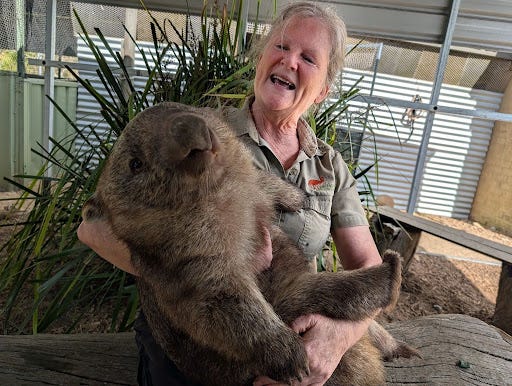
She loves to tell stories about Walkabout Wildlife Sanctuary, which she runs with her husband, Gerald. And one of her favorites is about the 2019 fire during Australia’s horrendous Black Summer.
For weeks, the deadly Gospers Mountain blaze ripped through the Wollemi and Yengo National Parks. Barnard had been rotating staff in 24-hour shifts at her sanctuary on the New South Wales Central Coast. She’d already moved most of her 200-plus animals — flying foxes, Tasmanian devils, koalas, wombats, dingoes — to 28 safe locations spread across the region.
Then the fire crew arrived with bad news: They told her the blaze would reach her sanctuary the next afternoon.
“There’ll be one fire engine,” the crew chief told her. She’d get 20 seconds on the phone with him when the fire arrived. His one question: Which fence did she want cut?
She went to bed just after midnight. At 3 a.m., she got up and posted to her sanctuary’s Facebook page. She wrote that she’d made a terrible mistake — that she should have moved the kangaroos and emus, that they were going to die.
“That was the first time I cried in five weeks,” she said.
Two hours later, her phone rang. A woman who’d been coordinating volunteers throughout the crisis asked her a question: If she could wave a magic wand, what would she need?
Barnard described the perfect rescue vehicle: An air-conditioned horse trailer with padded walls and stainless-steel hooks, so giant Eastern Grey kangaroos could be sedated and hung in bags without overheating on the drive out. She was certain nothing like that existed in her corner of the world.
The next morning, a man showed up with a horse trailer. A friend of the sanctuary had seen the post and called in a favor to a friend.
“I don’t know how the hell I got here,” he said, “but here I am.”
By 2 o’clock that afternoon, the last of the animals had been safely evacuated.
“We just wanted a quiet house in the bush”
Barnard’s sanctuary in Calga is about an hour north of Sydney in the sandstone ridgelines of the New South Wales’ scenic Central Coast. Barnard is not a zoologist or a career conservationist. She trained as a nurse, grew up in South Africa in an anti-apartheid activist family, and eventually landed an executive role in high finance in Melbourne. She and her husband weren’t looking for a calling when they stumbled onto this place in 2005.
“We just wanted a quiet house in the bush,” she says.
What they found instead was Calga Springs Sanctuary, an 80-acre feral-proof enclosure originally built by Barry Cohen, the former federal minister for the arts, heritage and environment. Cohen had spent 13 years predator-proofing the land after retirement.
Before the ink was dry on the sale, Cohen gave Barnard a lesson she says shaped everything that came after. By the end of his time overseeing Australia’s environment, Cohen had concluded that the biggest threat to native wildlife wasn’t land clearing, but the predators humans had introduced—foxes, cats and dogs. The cute and charismatic animals that dominate wildlife fundraising campaigns were being wiped out by animals nobody wanted to talk about.
But before she had time to do anything, the bulldozers arrived next door. And that brings us to the next story Barnard likes to tell.
Fighting a multinational mining company
A multinational sand quarry operation had plans to blast a 138-acre hole, 100 feet deep, into the sandstone aquifer right next to the sanctuary. The company’s technique wasn’t mining in any conventional sense. They were going to crush the rock itself, manufacturing sand from the aquifer that feeds the region’s hanging swamps — rare, slow-growing wetland ecosystems perched on cliff tops that depend on subterranean water flowing through the sandstone.
Barnard spent the next decade fighting them.
Her battle was maddeningly complex and financially draining. It included a two-year case in the New South Wales Land and Environment Court, and close coordination with lawyers, the Aboriginal land council, elders, archaeologists, and community members.
She says in the end, what saved the Calga Valley was a fact that the mining company had omitted from its application. It turns out it is an Aboriginal women’s ceremonial site, later determined by the court to be the most significant remaining women’s place in New South Wales. Every other known site of its kind in the state had already been destroyed.
The archaeologist the mining company had retained as an expert witness ended up testifying in favor of the sanctuary. Her letter, read aloud near the close of the case, was the moment Barnard’s lawyer turned to her and said, “We’ve got it.”
“That’s when I knew we had won the case,” Barnard said.
The court ruled against the quarry in December 2015. Then the Barnards spent another several years pursuing heritage listing for the site, so that a change of government couldn’t simply reverse the decision. On Oct. 1, 2019 — just weeks before those fire engines showed up at the gate — the government designated the Calga Valley Aboriginal Cultural Landscape, including the land owned by the mining company that was supposed to be strip-mined. It became the first privately owned site in Australian history to receive a state heritage listing against the wishes of its owner.
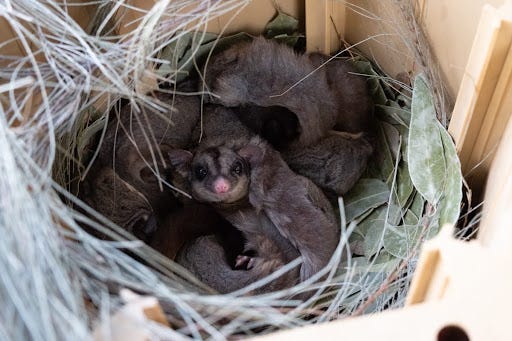
The sanctuary today holds more than 400 animals across roughly 180 species. There are Eastern Grey kangaroos wandering free through the bush. There are Tasmanian devils snarling at each other in an enclosure. There are koalas and flying foxes (sleeping, of course). And Dingoes.
When Barnard describes the place to a visitor, she talks about the smells — eucalyptus, rain, warm earth — and the sounds. Kookaburras, parrots and sugar gliders, which produce a rolling rumble startlingly large for such a small animal. And there’s Dexter, a sulphur-crested cockatoo who shouts, “Mooootherrr!” when he sees her.
But Barnard says this is no zoo. The enclosures exist because some animals can’t survive in the wild and need support, not because humans decided they’d look better behind a fence. The free-ranging animals choose whether to interact with visitors. And the whole enterprise is built around the concept of country, which she absorbed from her conversations with Aboriginal elders who work with the sanctuary.
Country, in Aboriginal cultural understanding, means everything. It’s people, animals, plants, water, weather, sky. It’s a relational framework, the idea that all of it is connected, that you can’t protect a koala by itself any more than you can protect a word by removing it from a sentence.
Barnard says that’s what bothers her about mainstream conservation. People want to save koalas. They donate to koala sanctuaries. Those sanctuaries are so well-funded, she says, and many are legally constrained from spending their donations on anything else. The koala money sits there while the animals that actually make koala survival possible slip toward extinction.
The grey-headed flying fox is one of them. It’s a keystone species — a nocturnal creature that can travel up to 30 miles in a night, spreading pollen from more than 100 species of native trees, including the gum trees that koalas need to eat and sleep. No flying foxes, no gums. No gums, no koalas.
But the flying fox doesn’t photograph as well as a koala. It looks like a giant vampire bat. But it’s essential.
“Your best financial contribution could be to save the flying foxes,” Barnard said. “Because they’re going extinct.”
No more greenwashing
At Walkabout, sustainability is done with an Aussie sensibility. Take the composting question, which Barnard sometimes gets from well-meaning visitors. The sanctuary takes in donated food from local supermarkets to supplement the diet of its 400-plus animals. Waste is inevitable. But it doesn’t do any composting with the waste.
Why not? Because Barnard crunched the numbers. The food volumes involved are enormous. Dig a pit the size of a large roadside sign, several meters deep, fill it with that compost — it would be at capacity in three months. Seal it improperly, or don’t seal it at all, and the nitrates leach into the soil, into the groundwater, into the roots of the native bush. The bush dies and the animals that depend on it follow.
Instead, some waste goes to the landfill. And around the areas where animal dishes get washed, the sanctuary has planted specific plant species selected to neutralize the nitrate runoff from the wastewater. There’s a small rainforest there now.
“There are so many things that we’ve had to make pragmatic calls on,” Barnard said.
Cardboard recycling is another one. The sanctuary gets one recycling bin for cardboard. A second bin costs money — money that, in the calculus of a self-funded nonprofit, competes directly with veterinary medicines and animal feed.
“Do you look after 420 animals, or 220 animals and spend the difference on extra cardboard bins?” she asks.
That’s the part of sustainability nobody wants to talk about. Barnard has little patience for what she calls “extreme greenies” — people who believe that humans shouldn’t have a footprint at all, that the only real solution is for people to absent themselves from nature entirely.
“Humans are animals, too,” she said. “But because we have the intellect that we do have, we can make choices.”
The choices she’s made haven’t always looked green from the outside. But the 80 acres at Calga are still standing. The hanging swamps are intact, the Aboriginal women’s site is protected and the grey-headed flying foxes still roost in their enclosures.
“Sustainability isn’t a buzzword”
The tragic fires during the Black Summer of 2019 burned for five weeks and devoured 59 million acres of bush. Barnard mobilized more than 170,000 people through social media — volunteers, vets, transport operators, licensed carers for specific species — to execute a triage evacuation. They saved all the animals.
Now the sanctuary works with Aboriginal fire practitioners, blending traditional knowledge of country with contemporary management techniques to reduce fuel loads safely. It’s not a purely indigenous approach, and it’s not a purely Western one. It’s the kind of pragmatic hybrid that Barnard’s whole operation represents.
“Sustainability isn’t a buzzword,” Barnard says. “It is the grueling, expensive, and deeply practical work of making calculated choices.”
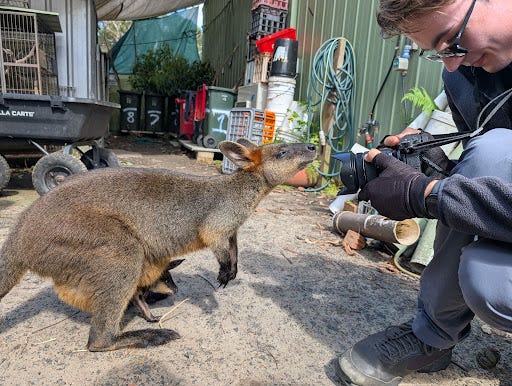
She pauses, watching a wallaby hop cross the path ahead of her.
“So that the bush lives to see tomorrow.”