

The milk at Sandhof farm in Freiamt, Germany, turns cold quickly.
It squirts out of the milking robot into a double-walled steel tank, where chilled liquid circulates through a jacket around the inner wall, drawing the warmth out.
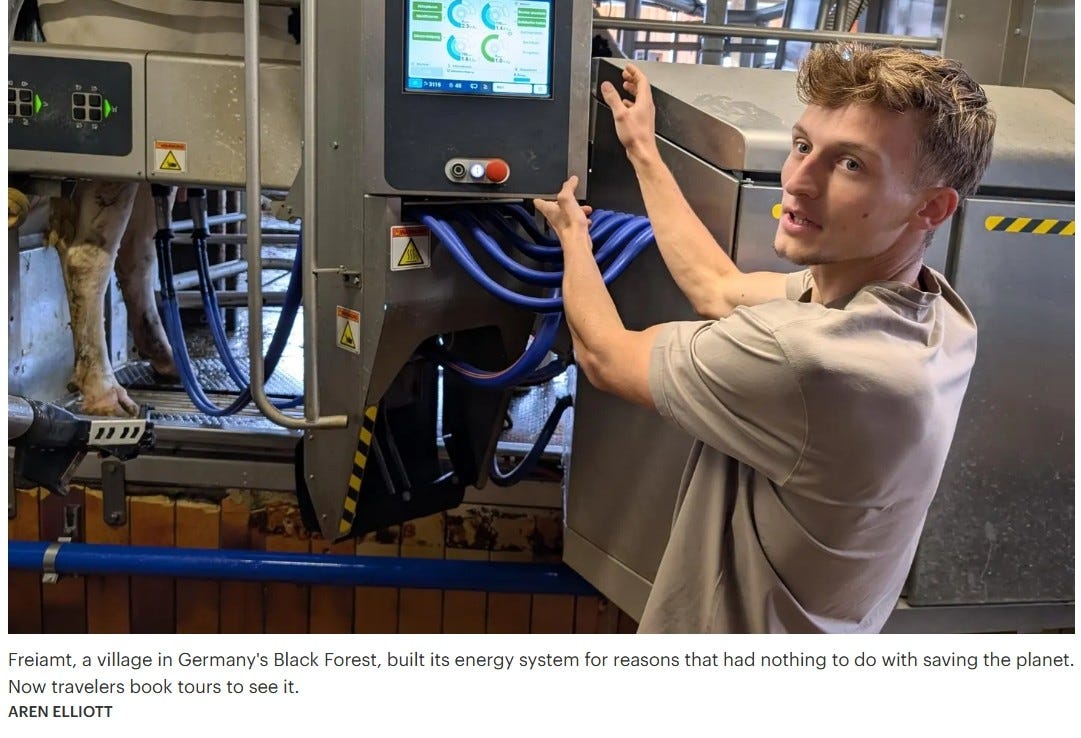
That energy moves into a hot water buffer, where it keeps the cattle troughs from icing over in January and then washes the milking equipment at the end of the day.
Upstairs from the tank, there are vacation rental apartments. Guests get heat from a wood-chip boiler fed by branches cleared from the farm’s own forest. On the ridge line, the oversize rotors of the community’s wind turbines turn slowly in a fall breeze.
Sandhof is a bio-farm in this rural community in the hills east of Freiburg, Germany. It has five wind turbines, a farm-scale biogas plant that heats the school and the public swimming pool, barn roofs covered in solar panels, hay dryers running on forest waste, and a tourism office fielding requests from visitors who want to see it all.
“Wind power and our bioenergy village status also serve our tourism sector,” says Karen Wittner, who directs tourism for the municipality. “We draw visitors from across Germany and abroad who want to see these installations firsthand and book specialized guided tours.”
It’s an interesting twist in the world of sustainable tourism. Freiamt didn’t build a sustainability attraction; it tried to harness green energy — and became a tourist attraction because of it.
The turbine on the ridge
Ernst Leimer got interested in wind in 1986, on a trip to the North Sea.
“I watched the wind turbines spin, and a switch flipped,” says Leimer, who chairs the local association that promotes wind energy in Freiamt.
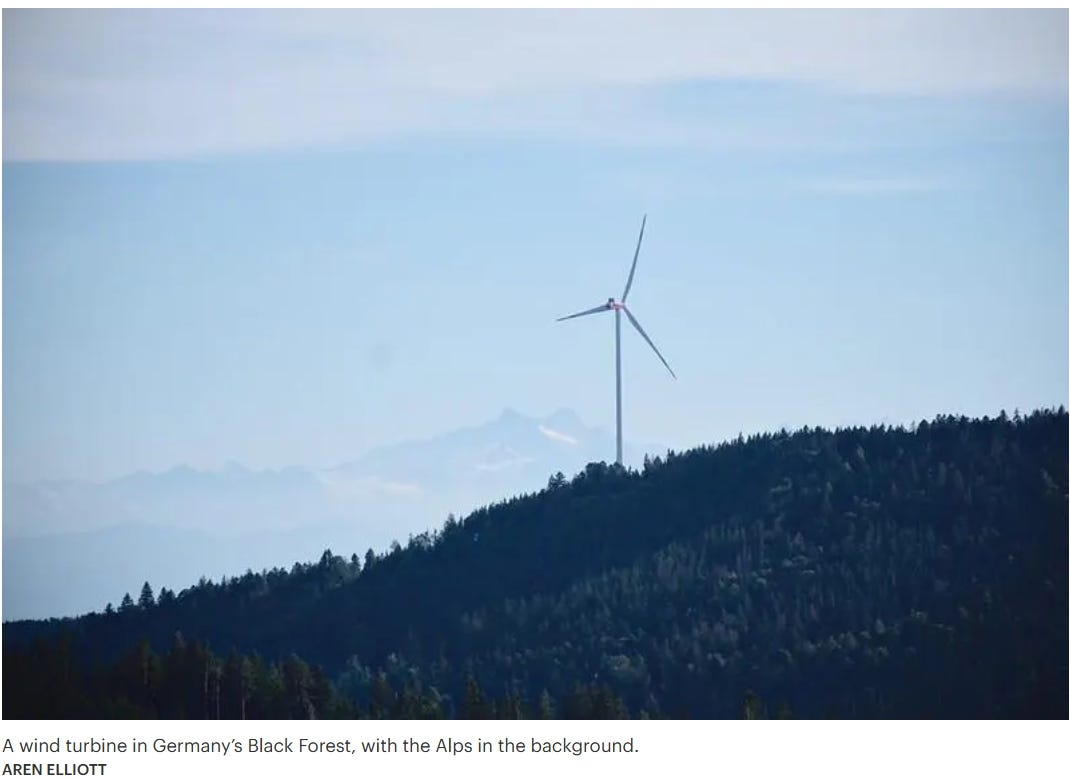
Ten years later, a commercial developer showed up in the valley, offering farmers a great deal on land leases. Leimer had spent a decade reading the trade press by then. He knew what usually happened next.
“I knew questionable firms operated in the sector that only wanted to lock up land rights,” he says. “After three years, those firms would disappear, nothing was built, and the farmer got the land back without receiving money.”
The response was the village’s DIY green electric project. Leimer had a conversation with Ökostrom, a Freiburg energy company, with one condition attached: Residents had to be able to buy shares, so the capital would circulate at home.
The first town hall meeting drew 80 people, the second about 200. Organizers laid sign-up sheets on the tables. The first two turbines cost roughly $4.5 million each, of which more than $1 million had to come as equity. Local citizens raised all of it in eight weeks.
More followed. A 2011 turbine brought in 165 shareholders, and a 2014 project added 105 more, under a separate company, because Leimer keeps each turbine in its own entity so a bad year at one can’t drag down the others.
The money mostly stays in the community. Shareholders see about a 5% average annual return. The municipality collects trade tax plus a legal royalty of 0.2 cents for every kilowatt-hour sold, which Leimer estimates at roughly $1.7 million to the town over the life of the wind farm. A turbine straddling the municipal line splits its lease payments with the neighbors. Households along the access roads get small annual payments.
The turbine is a behemoth and an Instagrammable moment for visitors. The nacelle, which houses the gearbox, weighs about 500 metric tons, the tower 1,000 tons of steel and concrete over a 1,500-ton foundation. In heavy weather, the top of the tower sways about 3 ½ feet in each direction, while the fiberglass blades flex almost 20 feet under load.
The farm that heats the school’s swimming pool and then some
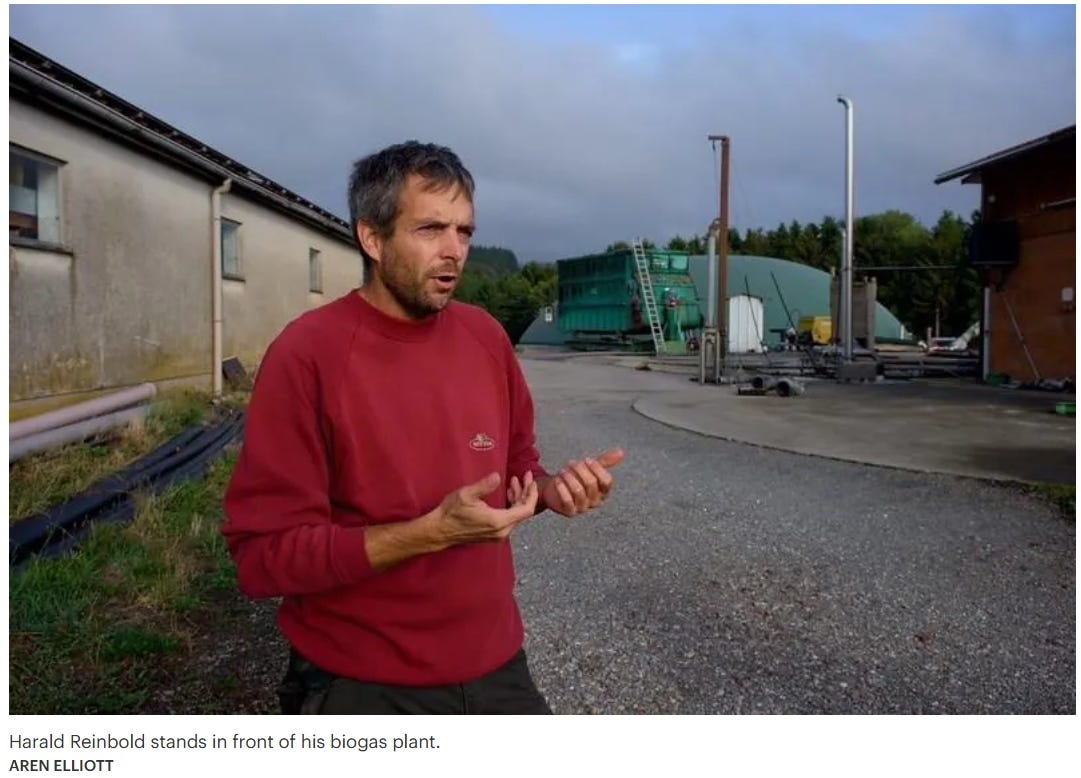
Down in the valley, Harald Reinbold used to raise bulls and pigs. He built a biogas plant as a second income stream, and then it took over the business.
His reasoning had nothing to do with carbon. Germany’s renewable energy law guaranteed a fixed rate per kilowatt hour for 20 years.
“That provided a degree of planning certainty that allowed us to secure financing,” he says. He points out that the same law paid for the wind and the solar.
The plant is a set of sealed tanks full of slurry, where bacteria eat grass silage, chopped corn and grain, then emit gas that’s about half methane. Since the livestock are gone, the manure comes in from neighboring farms. What goes back onto the fields afterward is a stabilized fertilizer that smells less than the starting product, with nutrients that crops take up faster. The digesters also assimilate corn straw and stalk residue that no animal can chew.
The gas burns in ordinary engines rated at 420 kilowatts. Waste heat off those engines runs a district heating loop that reaches nearby houses, the village school and the indoor pool. On the coldest nights, a wood-chip boiler and two big thermal buffer tanks cover the gap.
Feeding a digester is a lot more like keeping a sourdough starter than running a power plant. The bacteria eat once an hour, at a steady temperature, in a tank stirred constantly so the silage can’t raft up on top. Change the diet too fast, and the culture crashes.
Babysitting bacteria is just one more piece of Freiamt’s green initiative.
The smallest loop
Back at Sandhof, Thomas Reinbold farms about 40 hectares of grassland with almost 100 acres of forest behind it. The herd eats hay, never silage, which he says is easier on a cow’s gut. The milk carries more casein, so it makes better cheese.
The boiler in the yard has been running for two decades. Sandhof burns wood chips cut from its own woods, all of it material that would otherwise rot where it fell. The forest grows faster than the farm can burn it, so the surplus goes to other farms and to local hotels.
Thomas’s father bought the first wood-chip boiler in 2000. His explanation runs about 15 words:
“It keeps us independent of oil prices, which have spiked,” he says. “We are self-sufficient.”
That sentence explains the whole village. Nobody in Freiamt described what they’d built as environmentalism. Leimer organized to keep an outsider from tying up the valley’s farmland. Harald Reinbold wanted a second business. Thomas Reinbold burns his own timber because electric hay drying costs too much. The greenest town in this part of the Black Forest got that way by declining to send its money somewhere else.
Visitors have noticed, according to tourism officials. There are guided tours that cover the turbines, the biogas plant and the dairy, but perhaps the best way to experience it is to do a farmstay at a place like Sandhof.
There’s a catch, of course. Germany’s government price guarantee for green energy made every one of these projects bankable, and the clock runs out eventually. Leimer’s original turbine came down in 2025, its guarantee expired after 22 years of service. He put up a bigger one on a new, larger foundation.
The question isn’t whether the green energy initiatives in communities like Freiamt are working — it’s how much longer they will work. We’ll know the answer soon enough.